Showing posts with label stage 1. Show all posts

Friday, March 8, 2013

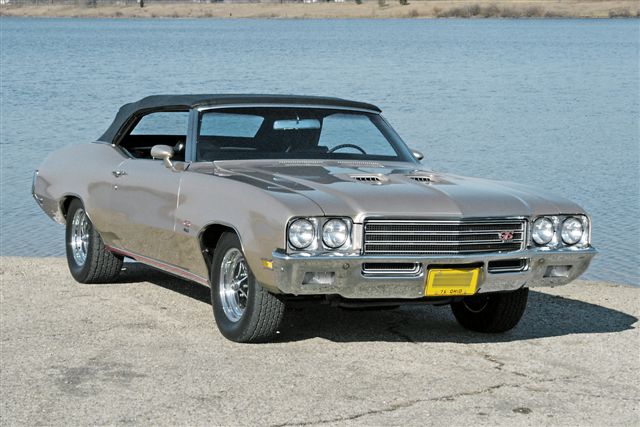
FAST FRIDAY: Buick GS for 1971


 Compression was down for 1971, lowered by GM corporate mandate to adapt to unleaded fuels, but the fun was not over yet. The GS for 1971 was offered both in GS 350 and GS 455 variants, in coupe and convertible body styles, and the 455 Stage 1 engine option was still offered.


It's not that the reduced compression went unnoticed. Dropping from 10.0:1 to 8.5:1 and detuning to run on regular fuels would affect anyone, Buick engineers included. The 455 saw a horsepower decline from 350 HP gross to 315, and even the mighty Stage 1 fell from 360 to 345. Transmission choices remained the same, but axle ratios did not- the 3.61: 1 was dropped from the options list. 

While the GS was still a very powerful car, the results were inescapable- The GS 455 was about  a second slower ET in the quarter mile. Times were changing already, and soon an oil embargo would replace "What'll she do?" with "What'll she get?" as fuel economy becomes a prime target for engineers. 

But for a couple more years, the Gentleman's Hot Rod, as the GS has become known, will stick around, although sales numbers would trend downward. Only 9,170 Gran Sports left the factory in total for the strike-shortened 1971 model year, which broke down as follows:

GS 350 Coupe- 5,986
GS 455 Coupe- 1,481
GS 455 Stage 1 Coupe- 801

GS 350 Convertible- 656
GS 455 Convertible- 165
GS 455 Stage 1 Convertible - 81

Oh, and of those 81 Stage 1 convertibles, only 9 had a manual transmission. And a total of 124 GSX were produced in 1971. Note that it was a trim option and is already included in the count of 9,180.

It's easy to see that the 1971 Buick GS was rare even when new and very highly prized indeed today.

Please enjoy our gallery of the GS 350 and GS 455 of 1971:  


Friday, February 24, 2012

Get to Know: The 1970 GSX


The success of the GSX show car all but guaranteed a production version, so no one was really surprised in the spring of 1970 when Buick announced the introduction of the very limited edition GSX. This was no stripe kit, but rather a very inclusive production option priced at $1196, plus of course a base GS455 Coupe.

The package included the standard 350 HP 455 V8 engine with 10.0:1 compression and 4 speed manual close ratio transmission with a Hurst shifter, plus a hood tach, G60-15 Polyglas tires on 7 inch wide V2 Chrome wheels, front air dam fiberglass rear spoiler, and outside color keyed sport mirrors. Special two color striping and GSX badging set off the exterior. Only two colors were offered, Apollo White or Saturn Yellow, which was a GSX exclusive color. Black was the only interior color.


Inside there was a custom interior with bucket seats, rally gauges and clock, 15' sport steering wheel, and special GSX identification. The chassis was loaded with goodies too- power front disc brakes, 3.42 rear axle with positraction, heavy duty cooling, large diameter front and rear stabilizer bars, heavy duty front and rear shock absorbers, and firm ride control arms and bushings. Quick ratio power steering was an often selected option, as was a Turbo HydraMatic 400 transmission.


But the biggest performance option of all was the Stage 1 455 engine, an additional $113 option for which the compression ratio was upped to 10.5 to 1 and the engine produced well in excess of its advertised 360 HP. There's a story there, but it's for another day.

The GSX sold rather well for such an expensive offering, with 678 examples assembled for 1970. Of those, statistics from the GSX Registry reveal that X00 had the Stage 1 455 engine and 479 had the Turbo HydraMatic transmission. Sensibly, a vast majority of buyers opted for quick ratio power steering- 613 in all. Color choices were a bit lopsided as well, with the Saturn Yellow accounting for 491 units and Apollo White only 187. But above and beyond its own sales, the GSX was a halo car for Buick and made the division's image more youthful and vital. After all, twelve year old boys don't hang posters of Electra Sedans on their walls. And yes, we were impressing the boys with our own 1970 Stage 2 drag car, but Buick decided to do it on a larger scale.

But was it really all that? In a word, a resounding yes. Motor Trend magazine got a hold of one and made a 13.38-second pass at 105.5 mph, prompting the magazine to name the GS 455 Stage 1 "the quickest American production car we had ever tested." Great plans were made for the future, including a Buick factory drag racer developed by Dennis Manner himself. But alas, it was not to be. The GM Corporate decision to reduce compression on the 1971 models triggered a swift decline for the supercars, and the GSX was quickly wound down. But the passage of time does not diminish the moment, and the 1970 GSX has a revered spot in the history of the performance car.

1970 GSX in Saturn Yellow

Another view of a Saturn Yellow 1970 GSX

The formidable 455 Stage 1 Powerplant

All '70 GSX models came with this black bucket seat interior

'70 GSX in Apollo White

Great shot of the spoiler- special striping was the same either color.

Friday, November 4, 2011

FAST on the STREET: The Stage 1 Story

1970 GSX Prototype at the Burbank Training Center. Provided by Dennis Manner whose handwritten notes are on the margin.

Last month we traveled to Michigan and had the opportunity to meet with some very important players in the story of the Buick Gran Sport. We spent an afternoon with Dennis Manner, Powertrain Engineer and father of the big block 400 and 455, as well as the 455 Stage 1 and Stage 2 engines. Dennis gave such a thorough and excellent explanation of the theory and execution of the Stage 1 engine that we decided the only way to do it justice is to print it verbatim. Here, in Denny's own words, is the story of the Stage 1:

"The objective, as we developed the Buick Stage 1 400/455-CID engines, was simply to provide maximum street performance in a vehicle sold from the showroom floor. We allowed no compromise of Buick features- if you wanted air conditioning, power steering, power brakes, power windows or seats, etc, they were available. This was no trick lightweight or stripped-down model, nor were any tinkering changes necessary once you bought it. There were no ifs, ands or buts about it- we optimized the Stage 1 package to move on the street.

Furthermore, we did not compromise the car's street performance so that it would be quicker at the drag strip. For example, a wilder camshaft would have provided more power when running without mufflers at the strip, but it would have reduced power on the street with an exhaust system.

The Buick 455-CID engine was designed to produce high torque durability and power relatively heavy cars, including the Gran Sports, which weigh in excess of 3600 pounds in typical street trim. The Stage 1 was an extension of that philisophy, to enhance the high torque characteristics of the engine, and focus on the automatic transmission for the majority of sales.

Heavy duty cooling and suspension, G-60 tires and Positraction rear axle combinations quickly became part of the package. We retrained the GS cold air induction air cleaner and developed a low-restriction dual exhaust to improve power and provide a pleasant sound while conforming to legal noise restrictions. The power development engine on the dynamometer was equipped with an exhaust system and air cleaner to ensure that our camshaft, carburetor, spark timing, compression ratio and valve sizes were focused toward developing real power on the street. Significant work was done to the camshaft, including the fitment of special valve springs and push rods to ensure clean valve train behavior at 6000 rpm. A higher pressure oil pressure spring was used to ensure adequate flow to the rod bearings at higher rpms.

We selected a 3.42 rear axle ratio on for air conditioning (3.64 for non-air cars) to maximize performance and driving enjoyment with the high-torque engine and G-60 tires. To further enhance street performance, the automatic transmission option was calibrated to allow downshift on demand, all the way back to first gear at speeds below 35 mph. This feature provided exciting acceleration in a rolling situation.

Larger valves with specially machined combustion chambers were developed for the 455-CID Stage 1 engine to improve the air flow characteristics of the larger bore size.

All of this special engineering was targeted toward the basic goal of maximizing total street performance. The axle ratios, camshaft timing, transmission calibration, valve size, exhaust system, fuel and spark all played their part.

It is rewarding to see a classy legend live on! "

-Denny Manner

Friday, September 30, 2011

Fast Friday: Fast Friends


We certainly did a lot of cool things on our recent trip to Buick's Home Town of Flint, Michigan - saw some awesome Buicks at the Sloan Museum, checked out some local cruise nights, caught breakfast with the local Buick Club of America folks, even did a driving tour past some of the old GM plants where many a classic Buick got their start. And along the way we crossed paths with some nice guys who  had a lot to do with Buick Performance and lent a hand to the Reynolds Buick Racing effort way back when.

Denny Manner (Left in the pictures) was hired into Buick Engineering upon graduation from the University of Minnesota in 1959. He was a weekend racer himself, so it would only be natural that he would being his love of performance engines along. One of his early projects at Buick was developing the dual-quad arrangement that was introduced on the 1964 Wildcat and Riviera.

Later he would serve as the Project Engineer in charge of the Stage 1 and Stage 2 455 engine programs. It was in that role that he became friendly with Jim Bell, tuner of the Reynolds Buick racing cars. It seems that Denny was developing high performance parts but didn't have the budget to campaign a drag car of his own, in addition the Corporation still had an official racing ban. The solution was to ship some test parts to a couple of successful Buick racing teams, most notably our own Kenne-Bell  Reynolds team. Both our '68 and '70 race programs benefitted from his support and it was a pleasure to meet him in person and discuss some of the finest hours in Buick's history. We are pleased to know him.

On the right in the pictures is Joe Guzek, retired Motor Wheel engineer and Buick racer himself from the time the cars were new. It was Joe who supplied the Motor Wheel Spyder racing wheels to Jim Bell for our 1970 GS 455 Stage 2, and Joe went on to create the chrome wheels for the 1986-87 Buick Grand National.

Joe met Denny Manner way back in 1970 when he was seeking input into a new car order that became his own 1970 GS 455 drag car- another Buick engineer referred him directly to Denny and it was the beginning of a long association. Two, actually- because Joe still has the 1970 GS 455 he ordered with Denny's input. He also knows Jim Bell personally from the racing days and is a friend to Reynolds and Buick Performance fans in general. It was great to get to know Joe and Denny in person and hope we can coerce them out to West Covina for one of our Open Houses in the near future.


Friday, June 10, 2011

fast friday: '69 Stage 1 vs '85 T-Type Turbo

This one is a battle of the Titans.

The Big Block Stage 1 High Performance 400 engine was introduced in the 1969 Buick GS400. The brain child of legendary Buick Powertrain engineer Dennis Manner, the
Stage 1 produced 345 hp. It featured a high-lift cam, 11.0:1 compression heads (instead of 10.25:1), a larger carburetor, specific fuel pump, and larger low-restriction exhausts. Like all '69 GS400 models, the hood scoop was actually functional and part of Buick's Cold Air Induction system. Dennis' mantra was "Fast for the Street", so the engine developed huge amounts of low end torque in order to launch away from the stop light.

The T-Type was a child of a different era. Lloyd Reuss developed the V6 as an economical powertrain and put a turbocharger on it in 1978 in order to provide performance more befitting a V-8. Despite pacing the 1976 Indy 500, the Buick V6 wasn't regarded as much of a performance engine until 1984, when a SFI version produced 200 hp. The Grand National was introduced that same year, and the performance hit its peak when the Intercooled version was introduced for 1986-87. Buick released a performance figure of 245 hp, but it is widely known to be understated, and is net hp compared to the gross rating of the '69.

So now our unscientific test- both cars are modified but street legal, so it's really just for fun. Can a little turbo 6 stand up to a 400 Stage 1?

Just remember they don't call it the 'little engine that could" for nothing.